|
Central & Eastern European Directory On-Line |
| College of Europe |
| Address | College of Europe, Dijver 11, BE-8000 Brugge, Belgium |
| Tel. No. | +32 (0) 5047 7111 |
| Fax No. | +32 (0) 5047 7110 |
| E-mail address | info@coleurop.be |
| Course title |
Bruges (Belgium) campus: |
| Type of course | Full-time |
| Length of course | 10 months: September - June |
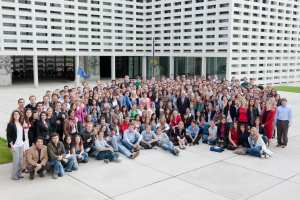
| Student body | In 2005-06, 384 students from more than 45 countries |
| Student profile |
1. Students at the College represent over 45 countries (47 in 2004/05).
2. Ratio Men: 45% Women: 55% 3. Age Range: The age range of students varies from 21 to the mid thirties. 4. Average Age The average age is 25. 5. Average Work Experience: The average work experience is six months to one year. |
| Top recruiters of our graduates | 24% of alumni work in the European institutions, 24% in the services sector (i.e. banks, consultancies, law firms), and 10% in each of the following: diplomatic service, national administrations and academia. |
| Fees | For 2006/2007, the fees are 16.800 euros, which include tuition, board and lodging in a student residence. |
| Financial assistance | 87% of students receive either partial or full scholarships. A student loan programme is also available. |
| Student accommodation | Students live in student residences |
| Admission requirements | All candidates for the College of Europe must hold a university degree. In addition, they should demonstrate an interest in European affairs and have the necessary background in their chosen field of study. Languages: The two working languages of the College are English and French. All students will be required to follow courses in both working languages. Language entry requirements differ depending on the study option, however knowledge of English should be at the B2 level according to the Council of Europe scale. |
| Application deadline | 31 January 2006; Start date: September 2006 |
| Contact for application | For questions, please contact the Admissions Office at info.admissions@coleurop.be |
| Rector | Paul Demaret |
|
European Advanced Interdisciplinary Studies (Natolin, Warsaw) The programme’s interdisciplinary approach implies that throughout the first semester students are introduced to the fundamentals of European politics and policies, economics and EU/EC law, and gain experience with the decision-making processes of the EU. The first semester is completed throughout the second semester by specialised courses covering five topics: Governance in the EU, the Single Market, the European Legal Framework, Central and Eastern Europe, and the EU as a World Actor. The Natolin programme accepts university graduates with a background in a wide range of disciplines, such as law, economics, political science, history, social sciences, philosophy, geography, linguistics, or journalism, demonstrating a high academic level and a keen interest in European affairs. European Economic Studies (Bruges) The programme aims at an in-depth specialisation in the economics of the European Union. The department offers a comprehensive coverage of European economic integration (process, policies, market functioning, liberalisation and regulation). All courses provide a blend of sound economic analysis and critical in-depth reviews of EU policies and, where relevant, of the European economy in general. The programme focuses on European public policy, but a range of courses also pays explicit attention to the implications for business strategies. A limited number of students of the department can participate in the European Law and Economic Analysis Specialisation. See www.coleurop.be for more information. European Legal Studies (Bruges) The programme provides students with an in-depth education in European law, the teaching methods being similar to those used in North American law schools. The programme establishes a balance between the economic and constitutional aspects of European law. The Legal Studies Programme emphasises both the increasing complexity of EU Law and the context in which it is evolving. It should be noted that the programme is particularly demanding and requires extensive preparation in advance of each class. A limited number of students of the department can participate in the European Law and Economic Analysis Specialisation. See www.coleurop.be for more information. European Political & Administrative Studies (Bruges) The programme provides students with a comprehensive understanding of the role and workings of the EU and its interaction at the international, national and regional levels. Courses, including one that is an interactive simulation game, encourage students to gain practical knowledge of complex EU decision-making procedures. Students develop interpersonal and communication skills through intensive teamwork and networking. Students follow four compulsory courses covering the politics of the EU, European Institutional Law and the Political Economy of European Integration. Students then choose three courses among eighteen options that explore in greater detail many of the policy areas and issues raised in the core curriculum. See www.coleurop.be for more information. EU International Relations & Diplomacy (Bruges) The programme provides specific knowledge of the European Union as an actor in the international environment as well as skills in international negotiations and diplomacy. It thus aims at a comprehensive understanding of the EU’s external relations bringing together an interdisciplinary analysis of its internal decision-making processes with developments in the broader context of international relations and diplomacy. Successful applicants will primarily come from an academic background in political science, European studies, law, economics or history, or be seconded from international organisations and national foreign services. Why study at the College of Europe? The academic quality and the variety of its postgraduate European study programmes are renowned worldwide. The College of Europe is the most genuinely 'European' of all the university institutes of European studies, in that it: - attracts a highly qualified pan-European faculty and welcomes students from across Europe and further afield - enjoys a truly European atmosphere on its Bruges and Natolin (Warsaw) campuses with students from 47 countries - can rely on its unique network of personal and institutional relationships developed throughout Europe and beyond over the past 56 years. In fact, the College of Europe is the world’s oldest university institute of postgraduate studies and training in European affairs. Finally, as the careers of many of its alumni illustrate, the College degree opens up rewarding professional prospects in Europe and at the international level. Study and experience Europe The academic programmes of Bruges – European Economic Studies, European Legal Studies, European Political and Administrative Studies, and EU International Relations and Diplomacy – and Natolin (Warsaw) – European Interdisciplinary Studies – provide students with a specialised grounding in the European dimension of their fields of study, as well as an in-depth understanding of Europe in all its complexity. By working together in a truly European community of students, teaching assistants, faculty and staff members from across Europe and beyond, students experience Europe first hand and benefit from a wide range of teaching methods, challenging teamwork and negotiation exercises. Entry requirements and rigorous selection procedures ensure that students who are recruited are of the highest calibre. The student body, 274 students in Bruges and 110 in Natolin (Warsaw), reflects a real diversity of culture and personal experience. Across both campuses, students come from over 45 countries and usually speak three to four languages. All have completed a university degree in a field appropriate for participation in the College’s postgraduate programme, and quite a number already hold a postgraduate degree. The students’ average age is 25. The one year programme lasts from September to the end of June and courses are taught in English and French. Important Contacts Students have the opportunity to meet policy-makers, practitioners, and representatives of the business community who often come as guest lecturers. In 2004-2005, the College welcomed José Manuel Barroso, President of the European Commission, Josep Borrell, President of the European Parliament, Bill Gates, Chairman and Chief Software Architect of Microsoft, as well as several European Commissioners, Heads of State, and numerous Ambassadors to its two campuses. Alumni Alumni of the College occupy positions of responsibility in Europe and across the world, and many come back to the College to share their experiences with the students. Twenty-four percent of alumni work in the European institutions, while an equally high percentage work in the services sector (i.e. banks, consultancies, law firms), with 10% working in each of the following: diplomatic service, national administrations and the academic arena. Application and Scholarships The application deadline is January 31. All candidates for the College of Europe must hold a relevant university degree. Candidates must submit an application for admission which consists of the completed application form (available at www.coleurop.be) and supporting documents. Approximately 87% of students are granted scholarships by their government, EU programmes, where applicable, or by another public or private institution. General Information: Location: two residential campuses, Bruges (Belgium) and Natolin (Warsaw, Poland) Qualification Awarded: • Bruges – Master of Arts in European Economic Studies, Master in European Community Law, Master of Arts in European Political & Administrative Studies • Natolin (Warsaw) – Master of Arts in European Interdisciplinary Studies Working languages: English and French |
|
Request For Further Information |
| Copyright © City Business Promotion Centre Ltd |